Ultrashort Pulse Laser Marking in Quality Comparison: When Standard is No Longer Enough
USP vs. "Standard": It's often said, "With laser marking, it doesn't matter what it looks like! As long as there's something on it!" We don't want rusting parts in our bodies, nor do we want to cut our food with a "rust-free" knife...
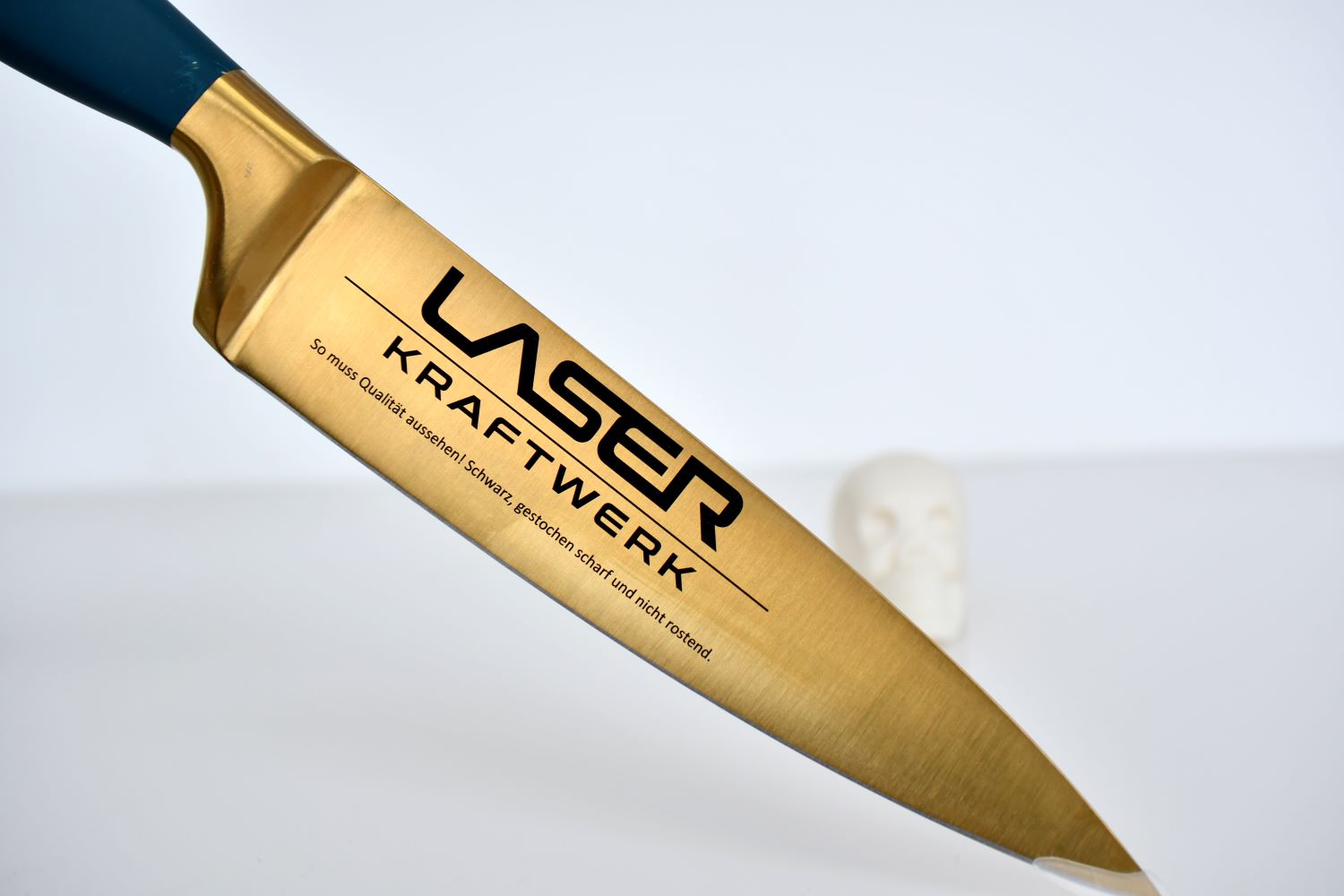
Ultrashort pulse laser markings...
- ...have extremely high precision (font sizes of less than 0.2 mm are perfectly recognizable under a microscope)
- ...are matte black & viewing-angle independent (no matter from which direction the product is viewed, the laser marking is always visible)
- ...do not corrode (clearly visible in the black laser markings)
- ...withstand many cleaning and reprocessing cycles (required for reusable surgical instruments, etc.)
What is "Standard" in laser marking?
CO2 and fiber lasers have been considered robust standard solutions in industrial marking for years.
- CO2 lasers operate in the infrared range (~10.6 µm) and are well-suited for organic materials, plastics, or wood.
- Fiber lasers with a 1064 nm wavelength are the "all-rounders" for metals, plastics, and ceramics.
Their pulse durations are in the ns-µs range, which leads to the creation of a heat-affected zone.
Problems with standard systems include:
- Annealing colors fade or corrode
- Contrast depends heavily on the material
- Cracks, burrs, or discoloration in sensitive materials
For many serial applications, these systems work well. But wherever maximum quality, material preservation, and precision are crucial, they reach their limits.
What makes USP different?
Ultrashort pulse lasers (USP) work with pulse durations in the femtosecond (fs) to picosecond (ps) range.
- The short energy input leads to immediate evaporation of the material => "cold" processing
- No melting, no heat-affected zone, no thermal damage
- The removal is highly precise, burr-free, and non-contact
- Even transparent or brittle materials (e.g., glass or ceramics) can be processed
This technology opens up applications that are not possible with standard lasers, especially where material properties must be maintained.
Example: Black marking on stainless steel and titanium
Typical areas of application include medical products such as surgical instruments or implants.
Advantages of USP laser marking include:
- Black, matte markings through nanostructuring of the surface
- No removal or annealing colors, thus the passivation layer remains intact
- Corrosion-free, even after 500+ sterilization and cleaning cycles (The real lifespan of instruments is closely tied to the specific application context and is often significantly shorter than the theoretical limit. This is not to be understood as a reflection of practice, but as proof of the durability of the marking under defined extreme conditions)
- Readable independent of the viewing angle => ideal for UDI codes
- Laser structure causes diffuse light scattering => no reflection
- Fiber lasers often only achieve thermally generated annealing colors => poorer durability
- Burr-free engravings are possible => without so-called "recast"
Conclusion: USP black marking is the laser-based method that is permanent, sterile, abrasion-resistant, and high-contrast, without any rework.