Superior Coating Performance
CWST’s Parylene offers unmatched protective and mechanical attributes: excellent dielectric and moisture barrier performance, dry-film lubricity, resistance to chemicals, and compatibility with delicate electronics or medical components. The process is green—producing no solvents or thermal stress.
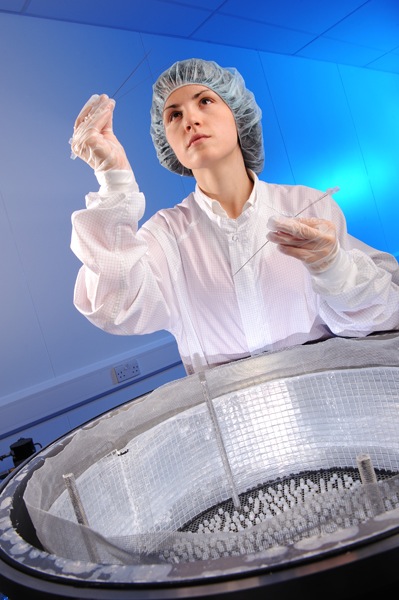
Parylene Conformal Coating Process
Parylene coating is performed in white and clean room facilities with custom-designed equipment derived from proprietary dimers. Parylene is applied under vacuum by vapor deposition at room temperature.
Stage 1 – SUBLIMATION
The dimer is heated in a partial vacuum to 150° C, converting from a solid to a gaseous state. The amount and purity of the dimer used dictate coating thickness and uniformity. Our proprietary dimers are 99.6% pure.
Stage 2 – PYROLYSIS
A gaseous dimer is heated in a furnace. As the temperature rises, the molecular structure changes and begins to crack or break down. At over 650° C, the dimer is split into monomers.
Stage 3 – POLYMERIZATION
In the deposition chamber, where the coating of the customer-provided product occurs, the coated parts are maintained at room temperature. Still, the monomer is drawn into the chamber in its gaseous phase and undergoes polymerization. The nanoparticles combine chemically to provide a chainlike or network molecule. At a rate of 1-2 microns per hour, a single clear coating builds up one molecule at a time, encapsulating all exposed surfaces. Controlled coating thicknesses ranging from less than 10 nanometers to 70 microns are achieved in a single operation.