Waterjet cutting in medical technology: precise, burr-free, without thermal stress
When precision counts in medical technology, the cut often makes all the difference. Waterjet cutting delivers burr-free to near-burr-free contours—without heat input—and is ideal for sensitive materials and demanding components.
What is water jet cutting – explained simply
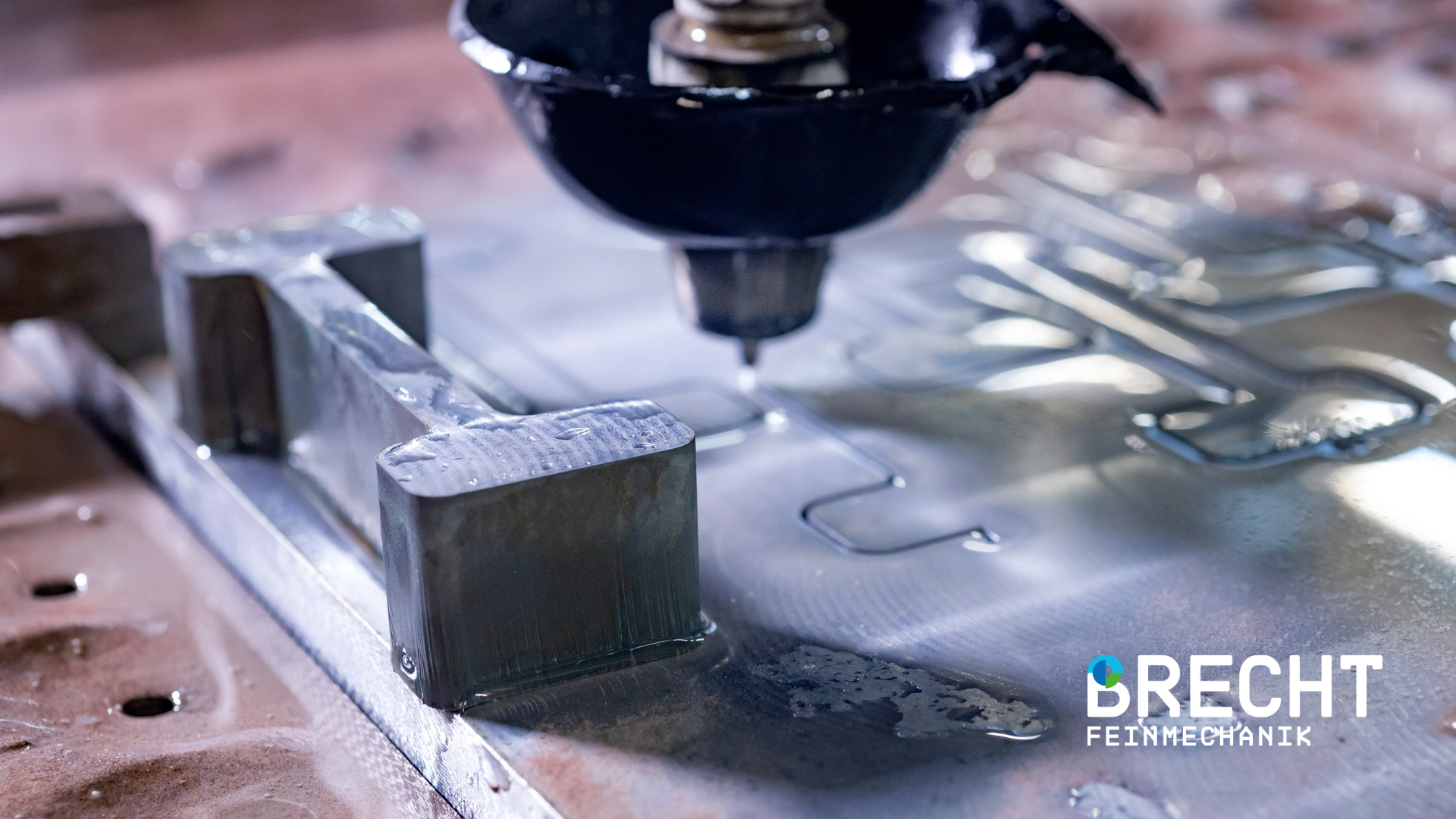
Water jet cutting involves cutting material using a high-pressure water jet – and, depending on the application, a fine abrasive. The process is particularly effective when material properties need to be preserved and very precise contours are required.
At Brecht Feinmechanik, water jet cutting has been part of the range of services since 2007 – with one of the most precise water jet cutting machines in the world and a cutting accuracy of up to ± 0.02 mm. This creates reliability, especially for medical technology components with critical fits.
The advantages for medical technology – the difference is in the details
-
No thermal stress – material remains material
Many materials used in medical technology are sensitive to temperature: their structure, surface, or functional properties can change. Waterjet cutting works without a heat-affected zone. This means no discoloration, no structural changes, and no distortion due to heat – a clear advantage when reproducible quality is essential. -
Low to no burrs – less rework, cleaner processes
Burrs are not just a visual issue in medical technology: they increase the risk during assembly, make cleaning more difficult, and drive up rework and testing costs. Waterjet cutting delivers very clean cut edges – often with significantly reduced deburring. This saves time and money and improves process stability. -
High precision – ideal for functional surfaces and fits
Every hundredth of a millimeter counts, especially for components that will later be joined, mounted, or installed as seals. With a cutting accuracy of ± 0.02 mm, Brecht Feinmechanik offers a level of precision that developers and purchasers alike appreciate: reliable results and better predictability in series production. -
Versatile with materials – from metal to plastic
Medical technology uses a wide range of materials. Waterjet cutting is suitable for many typical materials, such as stainless steel, titanium, and engineering plastics. This makes the process particularly attractive when different materials are used in projects or components are developed iteratively.
Typical application examples in medical technology
Waterjet cutting shows its strengths wherever complex contours, sensitive materials, and clean edges are required, for example in:
- Components for surgical instruments (e.g., contour parts, intermediate layers, functional sheets)
- Implant-related components and blanks made of titanium or stainless steel, where material properties must remain unaffected
- Housing, cover, and structural parts for medical devices – also as a preliminary stage for downstream processing steps
- Prototypes and small series, when speed is of the essence and quality must still be “suitable for production”
Brecht Feinmechanik is not only a manufacturer, but also sees itself as a holistic manufacturing and supply chain partner – from design and procurement to production, assembly, and delivery. And as a supplier with a focus on medical technology and a location in the “Medical Valley” near Tuttlingen, the company is close to the requirements of the industry.
Whether for prototypes or small/medium series, waterjet cutting is a powerful solution in medical technology when precise, clean cut edges are required – and when materials need to be processed without thermal stress. This is exactly where Brecht Feinmechanik comes in: with high precision, experience in demanding industries, and a clear eye for economical, reliable manufacturing.
Visit us at MedtecLIVE at our booth Hall 3 / 3-120 to learn more and speak to our experts in person.
For detailed information about our waterjet cutting services, visit our website: https://brecht-feinmechanik.de/wasserstrahlschneiden/