Lower costs. Consistent precision. No trade-offs.
Our injection molding process for amorphous metal components combines the best of CNC and polymer injection molding in one efficient process and reduces the cost of individual components by up to 50%.
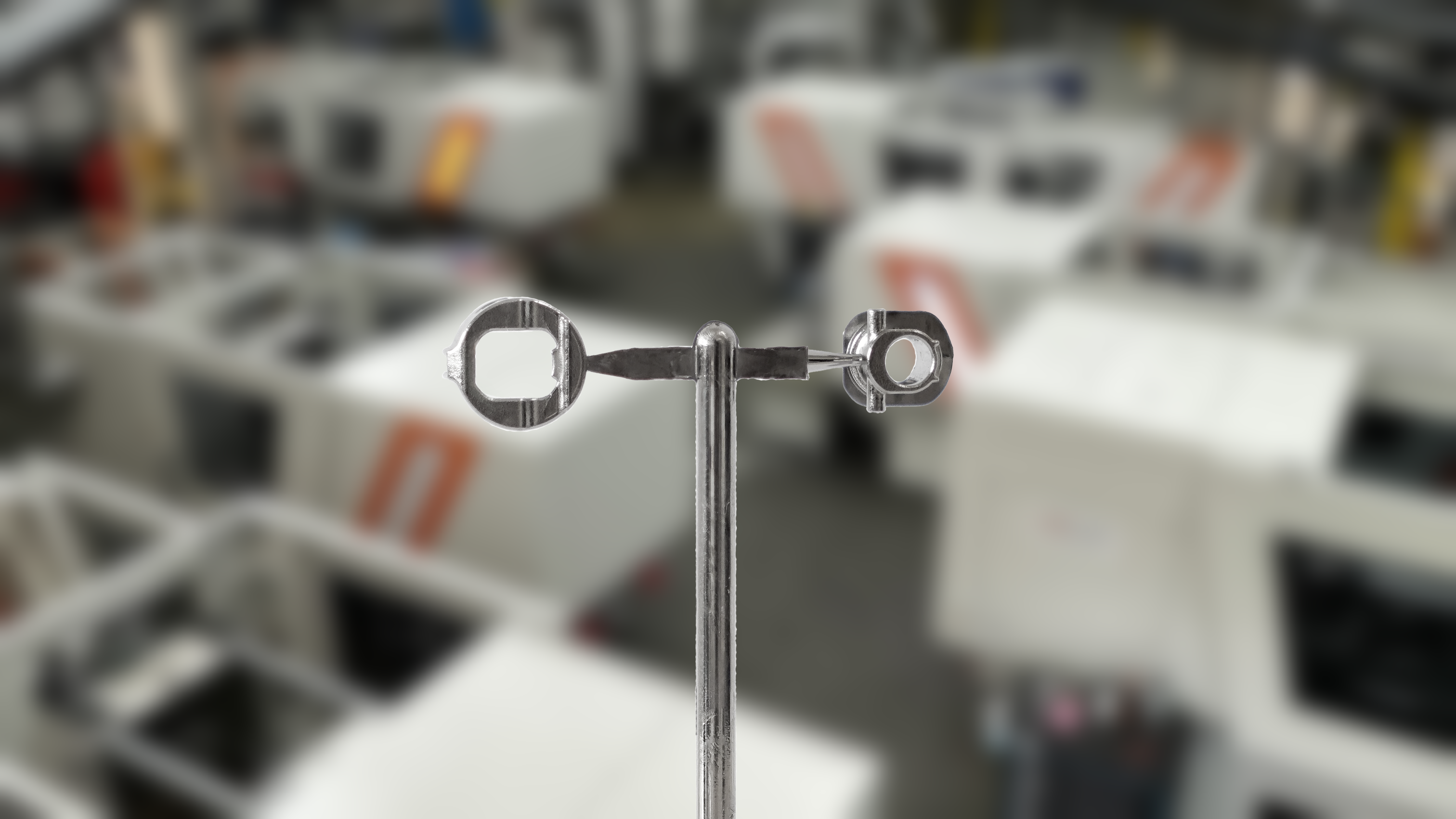
Increased efficiency through innovative injection molding of amorphous metals – your alternative to conventional CNC processes
Thanks to a significantly reduced cycle time, unit costs were reduced by over 50%. This was achieved by a leading OEM in the field of medical instruments. The component in question is a CNC-manufactured stainless steel part with an internal thread, which has an annual production volume of 10,000 pieces:
- Weight: < 10 g
- Wall thickness: 1 - 2 mm
- Tolerances: < ± 10 µm
| Status Quo: CNC processing of stainless steel |
Our Solution: Injection Molding of amorphous alloys |
|
|---|---|---|
| Tooling invest | 1.000 € | 35.000 € |
| Cycle time per part | 10 min | 2 min |
| Material per part | 0.20 € | 1.00 € |
| Processing per min | 2.00 € | 1.50 € |
| Cost per part | 20.75 € | 8.75 € |
Highest precision for complex metal components
With our innovative injection molding process, which was developed in-house for the production of amorphous metal components, we achieve results comparable to those of the CNC process and far exceed the precision of MIM and polymer injection molding. This makes our process a suitable replacement for the conventional CNC process when it comes to the production of small, highly complex metal components and medium to large series production. Our material replaces corrosion-resistant steels, stainless steels, and titanium alloys.
Our injection molding process enables the following component properties:
- Wall thickness: 100 µm – 5 mm
- Tight tolerances: ± 5 µm, low shrinkage (< 0.5%)
- Length tolerances: ± 0.003 – 0.01 mm
(5 times better than the MIM process: ± 0.02 – 0.05 mm) - Surface roughness: 0.05 µm
(20 times better than the MIM process: 1.00 µm3) - Component precision: 3–10 µm
(10 times better than the MIM process: 20–50 µm) - High-gloss surface, removal of parting lines possible
- Injection of internal structures possible
Our material is characterized by the following properties:
- High yield strength 1,600 MPa
For comparison: Ti grade 23 (860 MPa), spring steel (550 MPa) - Low modulus of elasticity 85 GPa
For comparison: Ti grade 23 (115 GPa), spring steel (190 GPa) - High corrosion resistance
Comparable to titanium or stainless steel - High resistance to steam sterilization
10 times better than stainless steel 1.4117 and 1.4021 - Elasticity 2% and high elasticity limit
Comparable to polymers - Certified biocompatibility
According to ISO 10993-5 and ISO 10993-12 - Low thermal conductivity 5-6 W/mK
Provides a warm feeling on the skin